Book an Appointment
Your Journey to Better Movement Starts Here!
Book your spot now and take charge of your health!
Inside the clinic
The therapies we use, and exactly why we use them
Twelve treatments, and not one of them is used on everybody. Your assessment decides which two or three your session actually needs — and every one of them is there to make the same thing possible: getting you loading, moving and back to what you stopped doing.
Below is what each one is, what it is genuinely good for, how it feels, and where we think the honest limits are. Read the ones that sound like your problem.
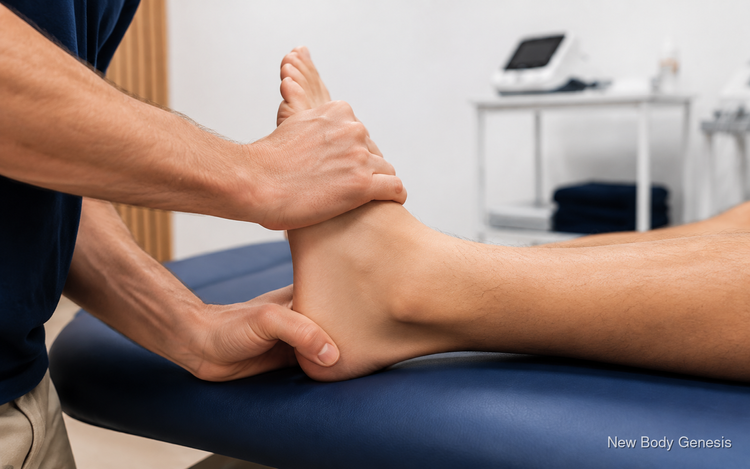
Manual therapy
Skilled hands finding the joint that has stopped moving properly — and giving it back its range.
What it is
Hands-on assessment and treatment of the joints themselves. Your physiotherapist moves a joint through its range, feels exactly where it resists, and applies graded pressure at that point to restore the movement. It is the oldest tool in physiotherapy and still the most informative one — a trained pair of hands picks up stiffness, guarding and end-feel that no machine measures.
When we use it
- A neck that will not turn far enough to reverse the car
- Lower back stiffness that is worst in the first hour of the morning
- A shoulder that has quietly lost its overhead range
- An ankle that never regained full movement after a sprain
- Stiffness left behind by a cast, a brace or an operation
How it feels
Firm, rhythmic and specific. You should be able to breathe and talk normally throughout — if you cannot, we are pressing too hard and we ease off. Most people describe it as a good kind of pressure, the sort you would lean into.
Mild soreness the next day is common and settles within 24 hours.
Why it matters
A stiff joint changes how everything around it works. The muscles nearby tighten to protect it, the joint above and below start compensating, and pain often appears somewhere other than the real problem. Restoring the movement removes the reason for all of that. Manual therapy opens the window; the exercise we give you afterwards is what keeps it open.
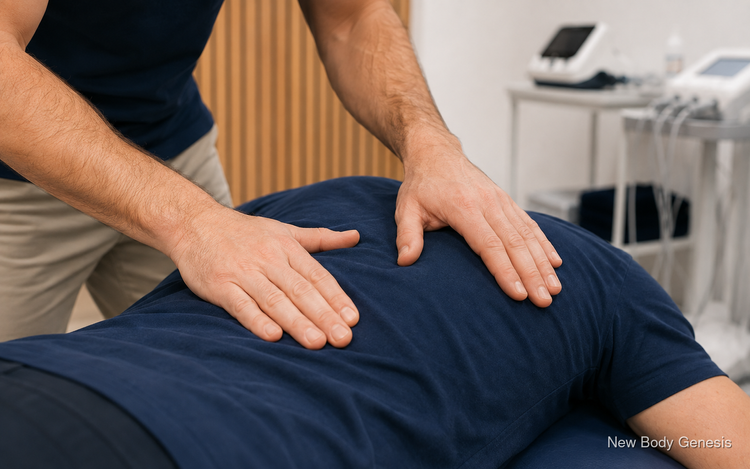
Spinal manipulation (HVLA)
The quick, precise technique behind the “click” — used deliberately, on selected patients, never as routine.
What it is
High-velocity, low-amplitude thrust. The joint is taken precisely to the end of its available range and given a small, fast, shallow impulse. The sound people associate with it is a pressure change inside the joint capsule — nothing moves out of place, and nothing is being “put back in”. It is over in a fraction of a second.
When we use it
- An acutely locked neck or mid-back that will not release
- Sudden lower back pain that has seized in one position
- Headaches arising from a restricted upper neck segment
- A stiff thoracic spine limiting shoulder movement or breathing depth
How it feels
A brief pressure, then release. It is faster than it is forceful, and it should not hurt. The relief is often immediate and can be dramatic — which is exactly why it needs to be used with judgement rather than as a party trick.
Why we say “selected”
Because not everyone should have it, and knowing who should not is the actual skill. We screen first — your history, your medications, bone health, and specific tests for the neck. If anything on that screen gives us pause, we do not do it, and we tell you why. If it is right for you, it is one of the fastest ways to unlock a joint that has stopped moving.
You will never be manipulated without being told what is about to happen and agreeing to it. If you would simply rather not, say so — mobilisation reaches the same destination more gradually, and we will take that route instead.
Not used with osteoporosis, inflammatory joint disease, blood thinners, recent fracture, or any red-flag finding on assessment.
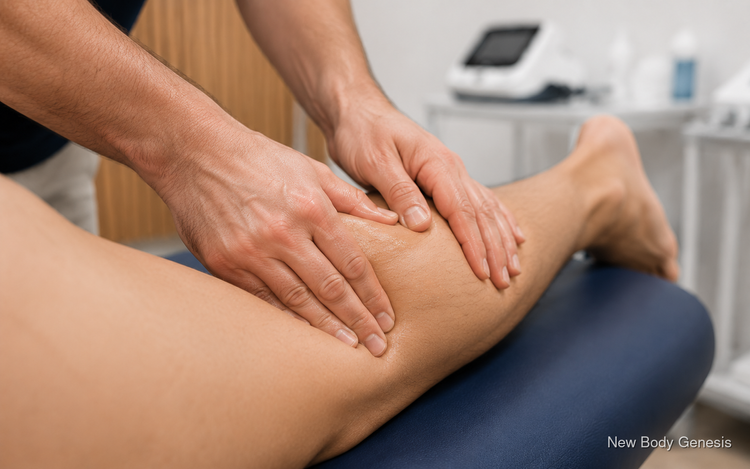
Soft tissue mobilisation
Deep, directed work into the muscle itself — treatment, not a relaxation massage.
What it is
Sustained pressure, cross-fibre work and trigger point release applied to a specific muscle that the assessment has identified as part of your problem. The difference from a spa massage is the targeting: we are not covering the whole body pleasantly, we are treating one or two structures that are driving your symptoms.
When we use it
- Calves that seize up in the second half of a run
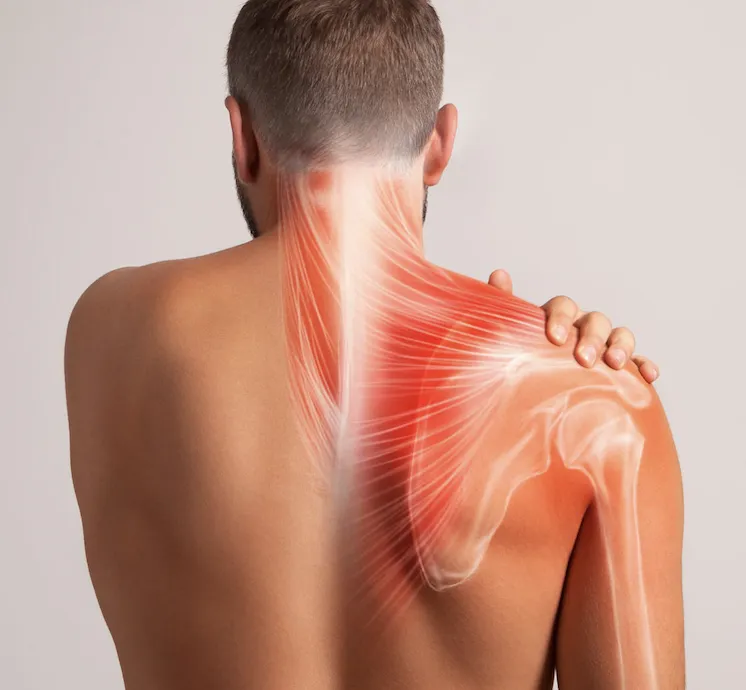
- Trapezius and neck tension that builds through a day at a desk
- Deep gluteal tightness referring pain down the leg
- Forearm tension in tennis elbow and in people who type all day
- Muscle guarding that keeps a joint from moving freely
How it feels
Deep, and at times right on the edge of comfortable — particularly over a trigger point, where the ache often spreads to somewhere else entirely. That referral is useful information, so tell us where you feel it. Pressure is always yours to adjust.
Why it matters
Tight muscle is rarely the whole story, but it is frequently the part that keeps the story going. Releasing it lowers the resting tension on the joint and tendon underneath, which is what makes the strengthening work afterwards feel possible rather than provocative.
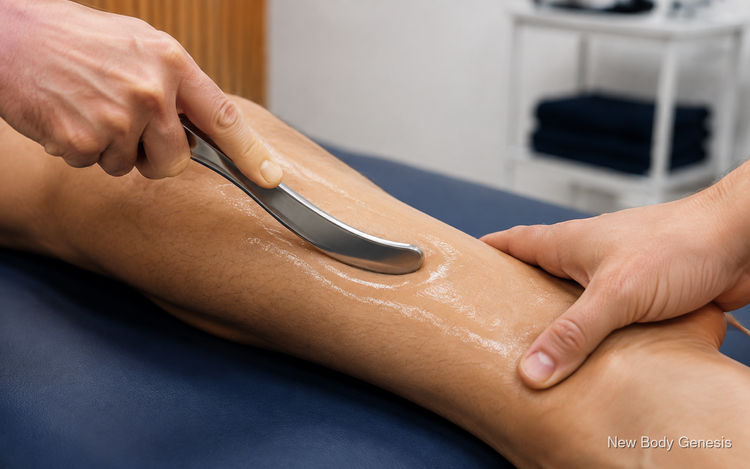
IASTM — instrument-assisted soft tissue mobilisation
A contoured steel tool that finds restriction a hand cannot feel, and treats it with a precision a hand cannot match.
What it is
A bevelled stainless steel instrument is drawn along the muscle over a thin emollient. The steel does two jobs at once. It transmits texture back to the therapist's hand — restricted, thickened or scarred tissue feels distinctly gritty through the tool — and it delivers a controlled shear force to that exact spot, at an angle and depth that fingers cannot sustain.
When we use it
- Scar tissue after surgery that has bound down to the layers beneath
- Chronic Achilles and plantar fascia thickening
- Dense, stubborn calves and IT band restriction in runners and cyclists
- Tennis and golfer's elbow that has been present for months
- Old injuries that healed but never regained their glide
How it feels
A firm scraping pressure. Over healthy tissue it is smooth and unremarkable; over restricted tissue you will feel it catch, and so will we. Mild redness afterwards is normal and expected — it fades within hours.
Why it matters
Tissue that has healed badly is not just tight, it is stuck to its neighbours — and stuck tissue cannot glide when you move. That is why an old injury can feel fine at rest and catch every time you push off. IASTM restores the glide, and loading afterwards teaches the tissue to keep it.
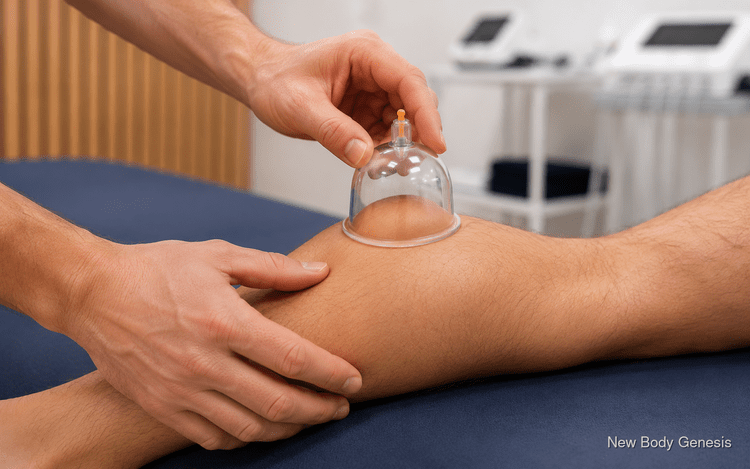
Cupping therapy
Every other technique presses tissue down. This one lifts it up — and that changes what it can reach.
What it is
A cup is placed on the skin and the air withdrawn, creating negative pressure that lifts the skin and fascia away from the muscle beneath. Where massage compresses, cupping decompresses. Cups may be left in place over one area, or moved along the muscle while the suction holds, and we often ask you to move the limb while a cup is on to combine the lift with movement.
When we use it
- Broad, heavy tightness across the upper back and shoulders
- Chronically dense calves, hamstrings and quadriceps
- Areas too large or too sensitive for sustained thumb pressure
- Fascial restriction that has not responded to direct pressure
- Loosening a region before it is loaded or stretched
How it feels
A strong pulling sensation, quite unlike anything else, and usually oddly satisfying. It should never be sharp or burning.
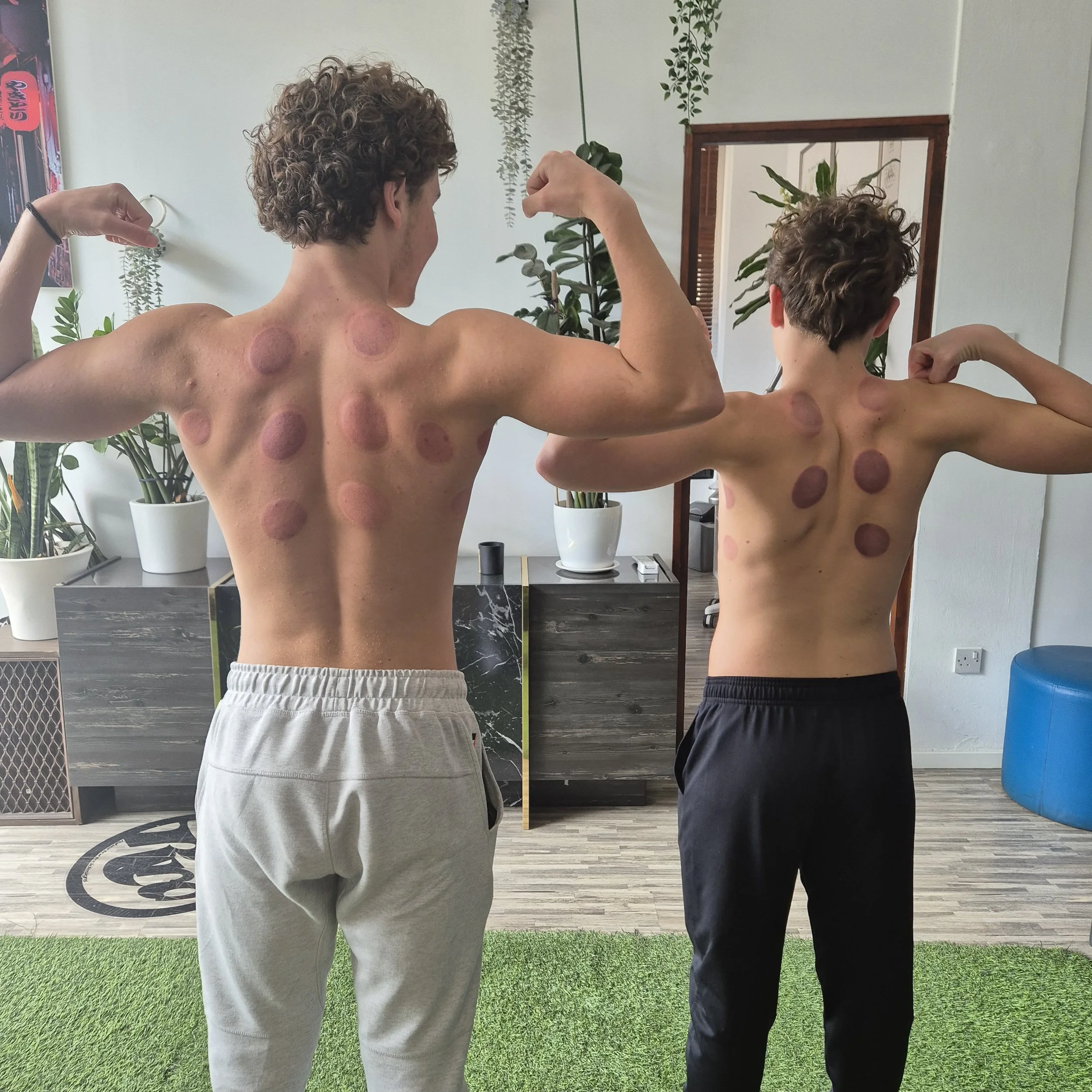
About the circles: the round marks are not bruises and they do not hurt. They are blood drawn towards the surface by the suction, and they fade over three to seven days. If you have a wedding, a beach day or a photoshoot coming up, tell us and we will use something else.
Being straight with you
Cupping will not detoxify anything — that claim belongs to marketing, not physiology. What it does do is reduce tissue tension and give short-term relief over broad, dense areas, and it does that well. We use it as one component of a session, honestly labelled, not as a headline treatment.
Not used over broken or fragile skin, on blood thinners, over varicose veins, or on areas with reduced sensation.
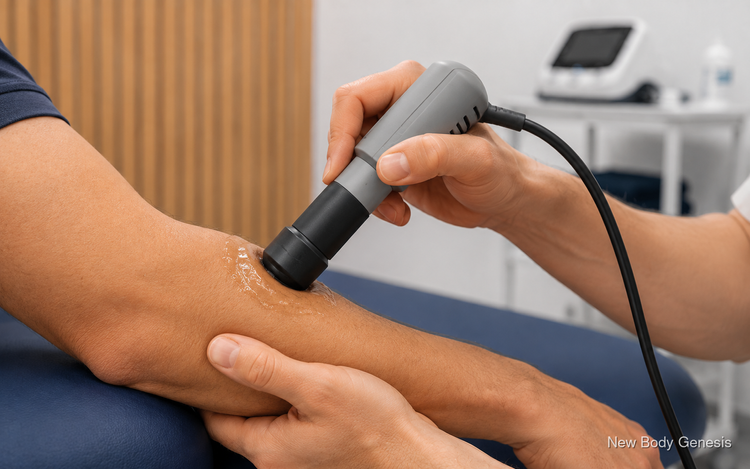
Shockwave therapy (ESWT)
For the tendon that has hurt for months and has stopped responding to rest, stretching and hope.
What it is
A handpiece delivers rapid acoustic pressure pulses into the tendon — around 2,000 of them in a few minutes. Here is why that helps: a tendon that has been painful for months is not inflamed any more. Its repair process has simply gone quiet, and the body has stopped treating it as a job worth finishing. Shockwave reintroduces a strong mechanical stimulus that restarts that process — new blood vessels form, repair activity resumes, and the overactive local nerve endings are desensitised along the way.
When we use it
- Plantar fasciitis — if the first steps out of bed are the worst moment of your day
- Achilles tendinopathy, both mid-portion and at the heel insertion
- Tennis and golfer's elbow that has outlasted the brace
- Gluteal tendinopathy — outer hip pain that makes lying on that side impossible
- Jumper's knee (patellar tendinopathy)
- Calcific shoulder tendinopathy, where a deposit has formed
How it feels
Loud and percussive, like rapid drumming directly on the sore spot, and briefly uncomfortable — we build the intensity up to what you can tolerate and stop where you say. Four to six minutes per area.
Expect redness and a dull ache for a day or two. Many people feel noticeably better that same evening, sore again the next day, then genuinely improved. That pattern is normal.
What to expect from a course
Shockwave is not a single miracle session. It works as a course of three to five treatments, spaced about a week apart, and it only holds if you do the progressive tendon loading we prescribe between them. Most people notice a real change by the third session. If you have had this pain for six months and nothing has touched it, this is usually the treatment that finally moves it — and it is the reason many patients come to us in the first place.
Not used over growth plates in children, in pregnancy, with blood thinners or clotting disorders, over an infection or tumour site, or directly over a major nerve or blood vessel.
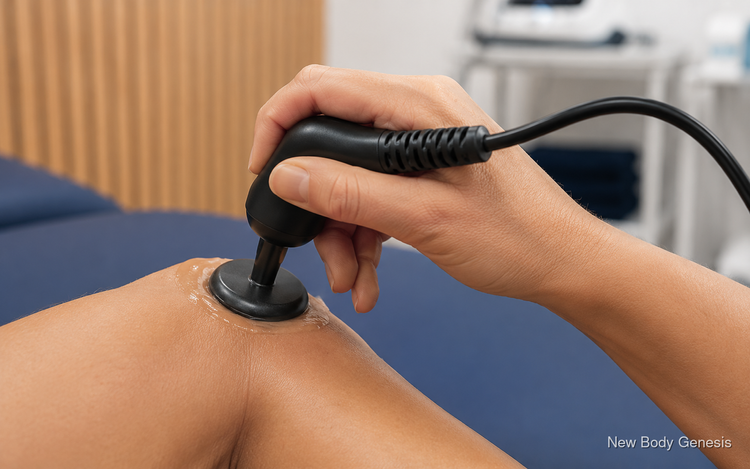
TECAR therapy (diathermy)
Deep warmth generated inside the tissue rather than applied to the skin — the most comfortable thing we do, and one of the most useful.
What it is
TECAR stands for capacitive and resistive energy transfer. A high-frequency current passes between a moving electrode and a return plate, setting the tissue's own charged particles in motion so the heat is produced at depth — several centimetres below the skin, where a hot pack never reaches. Capacitive mode works on muscle and soft tissue; resistive mode concentrates the energy in denser structures like tendon, ligament and the bone interface.
When we use it
- Acute muscle strains, to shorten the time before you can load again
- Deep joint stiffness in the hip, shoulder and mid-back
- Post-operative and post-fracture stiffness, once you are cleared to move
- Persistent swelling and sluggish circulation around a joint
- Warming up a guarded region so it tolerates the hands-on work that follows
How it feels
Genuinely pleasant — a deep, spreading warmth with the electrode moved in slow circles, closer to a warm massage than a treatment. You control the level. You should feel comfortably warm and never hot. There is nothing to recover from afterwards.
Why we reach for it early
TECAR is our opener. Ten minutes through a cold, stiff, guarded region buys visibly more range for everything that follows — the manual therapy goes deeper with less resistance, and the exercise is tolerated at a higher level. In acute muscle injury it lets us begin meaningful rehabilitation days earlier than we otherwise could, and in rehabilitation, days matter.
Not used with pacemakers or implanted electronic devices, in pregnancy, over active infection or malignancy, or where skin sensation is impaired. Tell us about any metal implants and we will adjust the mode.

Laser therapy (LLLT / cold laser)
For the joint that is too painful to touch — treatment that needs no pressure at all.
What it is
Low-level laser therapy, also called cold laser or photobiomodulation. It is called cold because it produces no meaningful heat: the light itself is the treatment. Specific red and near-infrared wavelengths are absorbed by enzymes inside the cell's mitochondria, which lifts local energy production, reduces inflammatory signalling and calms the sensitivity of nerve endings in the treated area. The dose in joules is calculated for each site — dose is what separates a laser that works from a red light that does nothing.
When we use it
- A flared, angry joint that cannot tolerate being touched yet
- Sharply localised tendon and ligament pain
- Nerve-related pain, including carpal tunnel and irritated nerve roots
- Swelling and bruising in the first days after an injury
- Wound and scar healing after surgery
- Painful arthritic joints, particularly knees and small hand joints
How it feels
Like almost nothing at all — occasionally a faint warmth as the probe passes. There is no pressure and no movement required, which is exactly the point. Eye protection is used whenever the beam is working near the face.
Why it earns its place
Every other technique here needs the tissue to tolerate contact, load or movement. In the first days after an injury, or in a joint mid-flare, none of that is available — and the usual advice is to wait. Laser lets us start treating on day one instead of day ten. Starting earlier is often worth more than any single technique.
Not directed at the eyes, over the abdomen in pregnancy, over the thyroid, or over an active cancer site.
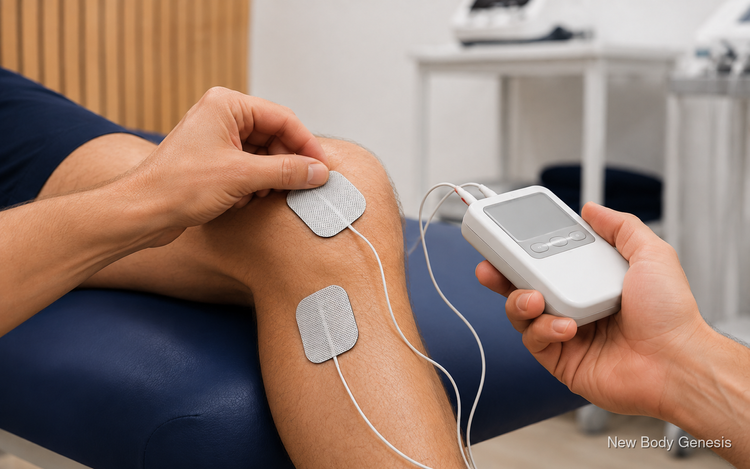
TENS & electrical stimulation
Drug-free pain relief you can control yourself — and, at a stronger setting, a way to wake a muscle that has switched off.
What it is
Adhesive pads deliver a controlled current through the skin, doing one of two jobs depending on the setting. TENS stimulates the large sensory nerves, which crowds out pain signals travelling to the brain along the same pathway — the pain gate. NMES uses a stronger current to make the muscle physically contract, reaching fibres your brain has temporarily lost access to after injury or surgery.
When we use it
- Persistent back and neck pain, as an alternative to reaching for tablets
- Quadriceps that will not activate after knee surgery or ACL reconstruction
- Muscle wasting after time in a cast or brace
- Arthritic joint pain, especially knees
- Pain flares between appointments, using a unit at home
How it feels
TENS is a comfortable tingling or buzzing you adjust to your own preference. NMES is stronger — a firm contraction you can watch happen in the muscle. Strange the first time, but not painful.
Why it matters after surgery
After a knee operation the quadriceps often simply will not switch on, no matter how hard you concentrate. No amount of exercise fixes a muscle you cannot contact, and every week it stays offline is strength you will have to rebuild later. NMES bridges that gap until voluntary control returns — then we stop, and you take over.
For ongoing pain we will set up a unit for you to use at home and teach you the pad placement, so relief is not something you have to book an appointment for.
Not used over pacemakers or implanted stimulators, across the chest, over the front of the neck, over the abdomen in pregnancy, or on broken skin.
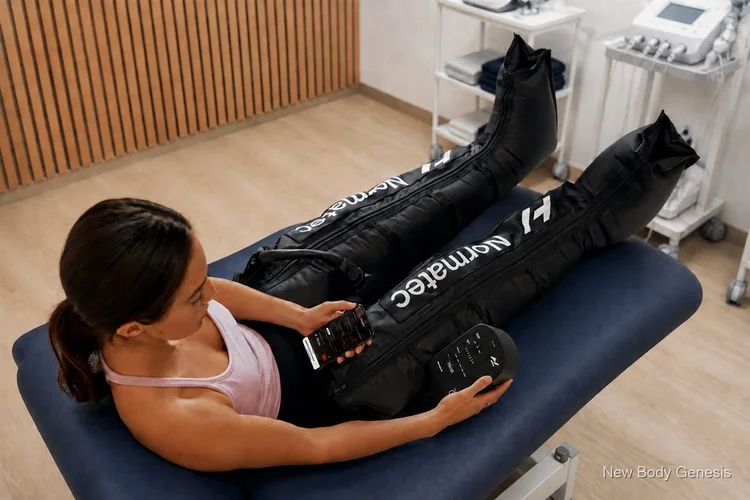
Compression therapy (Normatec boots)
Twenty to thirty minutes that leaves heavy, swollen, race-worn legs feeling like they belong to you again.
What it is
Full-length boots inflate in sequence from the foot upward, in overlapping chambers, then release — a pattern built to mirror the way muscle contraction normally drives blood and lymph back towards the heart. When you have been still, swollen or worked to exhaustion, that natural pump is doing a poor job, and the boots do it for you. We use Normatec, the system most professional sports teams use.
When we use it
- After a race, a match or a heavy training block — heavy, dead legs
- Swelling that lingers around an ankle or knee weeks after injury
- Post-operative swelling, once your surgeon has cleared compression
- Between competition days, when recovery time is short
- Legs that ache and swell after long flights or long days standing
How it feels
A firm, travelling squeeze moving up the leg and releasing, over and over. Most people find it deeply relaxing — bring your phone, answer your messages, and get up feeling lighter. Pressure is adjustable and should never be uncomfortable.
Being straight with you
Compression will not make you stronger or fitter, and it does not replace sleep, food or training. What it reliably does is reduce swelling and make you feel substantially better, sooner — and an athlete who feels fresh on day two trains better on day two. For genuine swelling and lymphatic congestion, the mechanism is well established. We use it for what it actually does.
Not used with DVT or a history of blood clots, acute infection in the limb, uncontrolled heart failure, or an unhealed fracture in the leg. We screen for these before your first session.
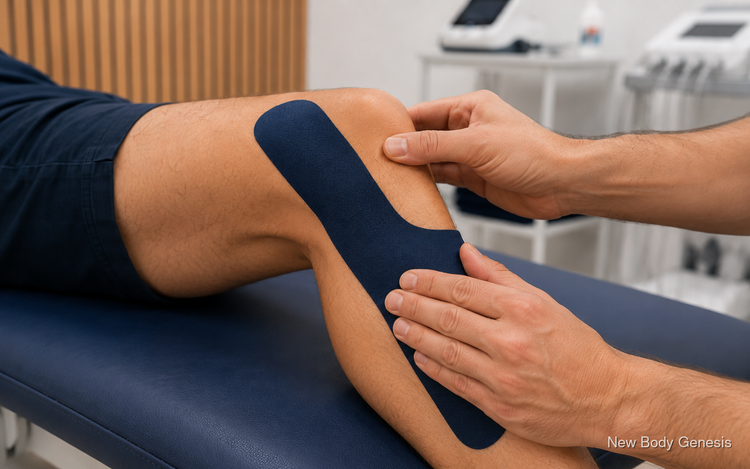
Kinesiology taping
Treatment that keeps working after you leave — for the next three or four days, through showers and training.
What it is
Elastic cotton tape applied along a muscle or around a joint at a specific tension and direction. Unlike rigid strapping it does not restrict movement. It lifts the skin very slightly and provides constant sensory feedback to the area — and that feedback is the mechanism that matters: it changes how you sense and use the joint while you move.
When we use it
- Knee pain in runners — patellar tracking and jumper's knee
- An ankle returning to sport after a sprain, needing support without stiffness
- Shoulder and postural taping for desk workers, as a reminder rather than a brace
- Swelling and bruising, using a fan pattern to assist drainage
- Carrying an athlete through a competition while the real rehab continues
How it feels
You notice it for ten minutes, then forget it is there until you move in the direction it is guarding. It stays on for three to five days, survives showering and sweat, and comes off painlessly if you peel it slowly along the skin.
Being straight with you
Tape does not hold a joint in place, and any claim that it lifts fascia to a measurable degree overstates the evidence. What it does well is give continuous sensory input that helps you move more confidently and less protectively, plus real assistance with swelling. That is a modest mechanism with a genuinely useful effect — we use it as a bridge between sessions, never as the treatment itself.
Tell us about adhesive allergies or sensitive skin — we can test a small strip first.
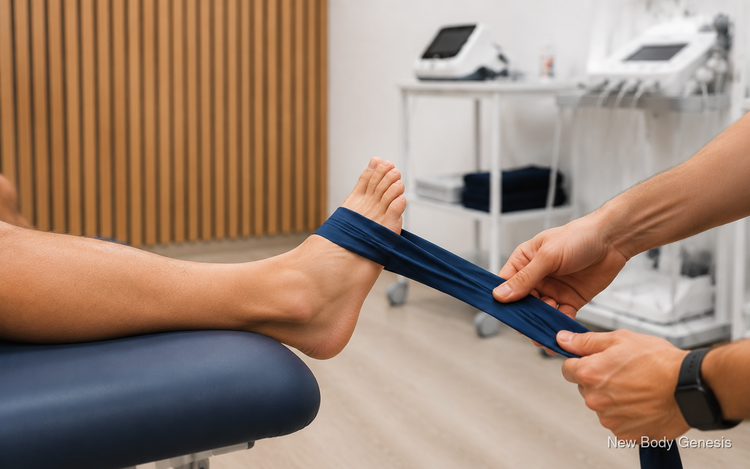
Exercise rehabilitation
The part that makes the change permanent. Everything else on this page exists to make this possible.
What it is
Prescribed, progressively loaded exercise — specific sets, repetitions, tempo and resistance, adjusted at every visit according to how your tissue responded to the last one. It is not a photocopied sheet of stretches. Tissue adapts to the demand you place on it, and graded load is the only signal that reliably drives that adaptation. Tendons, muscle, bone and cartilage all obey it.
When we use it
- Tendinopathy, where loading is not an add-on but the actual treatment
- Return to sport after ACL, ankle or shoulder injury, against objective criteria rather than a guess
- Persistent back and neck pain, rebuilding capacity and confidence in movement
- Post-operative rehabilitation, staged through your surgeon's protocol
- Scoliosis and postural strengthening programmes
- Making sure the same injury does not come back next season
How it feels
Like work — and it should. Some pain during loading is often acceptable and even expected; we agree that boundary with you beforehand, and it should settle within 24 hours. Progress is decided by measurement, not by how the day happens to feel.
Why it leads everything else
Manual therapy, shockwave, TECAR and laser change how tissue feels, for hours or days. Loading changes what tissue can withstand, and that change is structural. It is the difference between leaving the clinic comfortable and leaving it capable.
This is why no session here ends on the treatment couch, and why you always leave with a programme to continue at home. Passive treatment alone will keep you coming back. That is not what we are for.
So which of these will I actually get? Whichever ones your assessment points to — usually two or three in a session. A typical visit for a stubborn tendon might open with TECAR to warm the area, move to shockwave on the tendon itself, and finish with the loading exercises that make the change stick. A locked neck might be manual therapy, a selected manipulation, and a home programme. Nothing here is sold as a standalone package, and if a technique is not right for you, it is not used.
Questions we get asked before booking
Straight answers, including the ones that are not in our commercial interest.
How many shockwave therapy sessions will I need?
Three to five, spaced roughly a week apart. Most people notice a genuine change by the third. If you have had no change at all after four sessions, we stop and reassess rather than sell you a fifth — that usually means the diagnosis needs revisiting, not that you need more shockwave.
Does shockwave therapy hurt?
It is uncomfortable for the four to six minutes it runs — a loud, percussive drumming right on the sore spot. We build the intensity up to what you can tolerate and stop where you tell us to. Afterwards expect redness and a dull ache for a day or two. Almost nobody finds it unbearable, and most people are surprised how short it is.
What is the difference between TECAR and shockwave therapy?
They do opposite jobs. TECAR delivers deep, comfortable warmth to increase circulation and loosen stiff tissue — it prepares an area and speeds recovery. Shockwave delivers sharp mechanical pulses to deliberately provoke a stalled tendon back into repairing itself. TECAR is soothing and used often; shockwave is intense and used in a short course for chronic tendon pain. They are frequently used in the same treatment plan for different reasons.
Is it safe to have your back or neck manipulated?
For appropriately screened patients, yes — and screening is the point. We check your history, medication, bone health and specific neck tests before any manipulation, and if anything gives us pause we simply do not do it and explain why. You will always be told what is about to happen and asked first. If you would rather not, joint mobilisation reaches the same place more gradually and works perfectly well.
Do the cupping marks mean it is working?
No. The circles are blood drawn towards the skin by suction, and they reflect how your tissue responds, not how effective the treatment was. They are not bruises, they do not hurt, and they fade in three to seven days. If you have an event coming up, tell us and we will use a different technique.
Is cold laser therapy the same as the red light devices sold online?
No, and the difference is dose. Clinical laser therapy delivers a calculated number of joules at specific wavelengths to a defined area. Most consumer red-light devices deliver a small fraction of that, spread over a wide area, which is why they tend to do very little. The mechanism is real; the dose is what makes it work.
How long before I feel a difference?
Stiffness and acute muscle problems often change within one or two sessions. Chronic tendon pain is measured in weeks — usually three to six, because tendons remodel slowly and no machine changes that. At your first appointment we will tell you which category you are in and roughly how many sessions we expect, so you can judge progress against something concrete rather than hoping.
Do you accept GESY?
Yes. GESY sessions are available at our Nicosia clinic at the standard €10 patient contribution. Private appointments are also available, and if you are not sure which route suits your situation, the session finder on our site will point you to the right one.
Which therapy do I need for my problem?
That is genuinely not answerable from a website, and anyone telling you otherwise is guessing. Heel pain that is worst on your first steps of the morning points one way; a neck that locked overnight points another. The assessment at your first appointment decides it — or use our session finder, which asks the same questions we would and gives you a starting point in a couple of minutes.
I am not in Nicosia. Can you still help?
Yes. Online consultations include a review of your MRI or X-ray imaging and a rehabilitation programme you follow at home, with follow-ups to progress it. Hands-on techniques and the equipment obviously need you in the clinic, but the loading programme — the part that produces the lasting change — travels perfectly well.
Book your session at NBG Physiotherapy
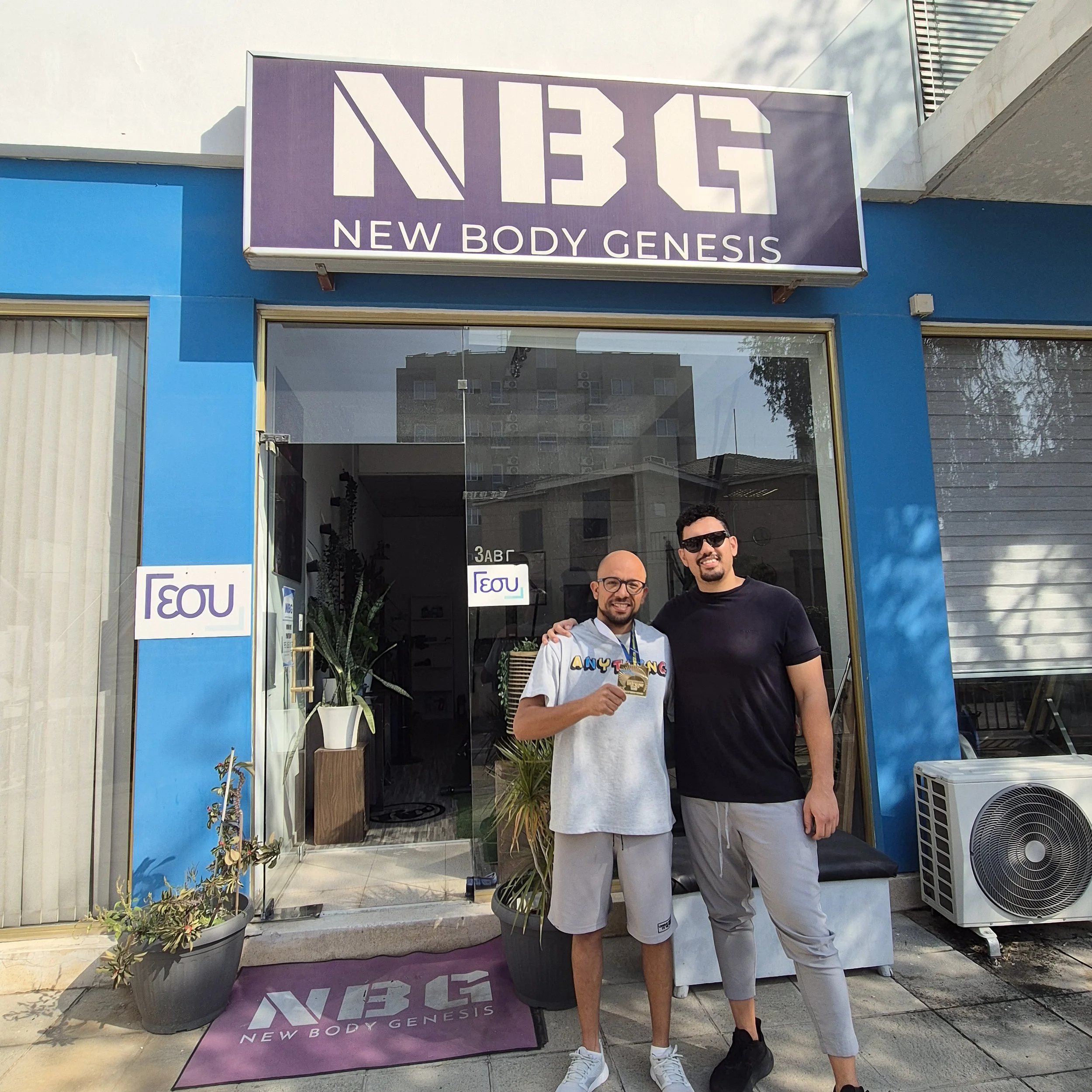
Personalized physiotherapy and exercise rehabilitation with Christos Rakotoarivelo, Head Physiotherapist of NBG Clinic. Every session is designed around your pain, movement, posture, strength, and recovery goals.
At NBG, we combine hands-on therapy, corrective exercise, strength rehabilitation, kinesiology taping, TENS, cold laser therapy, red light therapy, shockwave therapy, recovery tools, and modern physiotherapy techniques to help you move better, reduce pain, and return stronger.
Whether you have back pain, neck pain, sports injuries, muscle tension, posture problems, scoliosis, osteoporosis, or you simply want to improve your body, we focus on real results with a clear plan.